
This post contains affiliate links, which means I may receive a small commission, at no cost to you, if you make a purchase through a link.
“This aggressive cut meal plan is built around one goal: maximum fat loss in minimum time, without sacrificing the muscle you’ve worked for.”
Want to lose fat fast — without losing muscle or feeling like you’re starving? This plan keeps your protein sky-high, your calories under 1,500, and your cravings surprisingly under control.
Let me be real with you for a second.
Most people who want to lose weight try the same thing: eat less, push through the hunger, and hope that willpower carries them to the finish line. It works for about four days. Then life happens — a long day at work, one skipped meal, one bad night’s sleep — and suddenly they’re standing at the fridge at 10pm eating cold leftovers straight from the container.
I’ve been there. Most people have.
The problem isn’t you. It’s the plan — or rather, the lack of one.
An aggressive cut isn’t about suffering through hunger. It’s about eating strategically. High protein keeps your muscle safe and your hunger manageable. A controlled calorie deficit burns the fat. Structure removes the daily decisions that drain your willpower before dinner even arrives.
This 7-day plan gives you all three. No chef skills required. No expensive superfoods. Just real food, clear numbers, and a plan you can actually follow.
Here’s what you’ll find on this page:
- ✅ A full 7-day meal plan (breakfast, lunch, dinner, and a snack every day)
- ✅ Daily macro targets explained in plain English
- ✅ A complete grocery list you can screenshot and take straight to the store
- ✅ The 5 habits that separate people who finish the week from people who quit on Day 3
- ✅ Three proven fat-loss programs for when you want to go deeper
- ✅ Honest answers to every question I get asked about cutting calories
Grab a coffee. Let’s get into it.
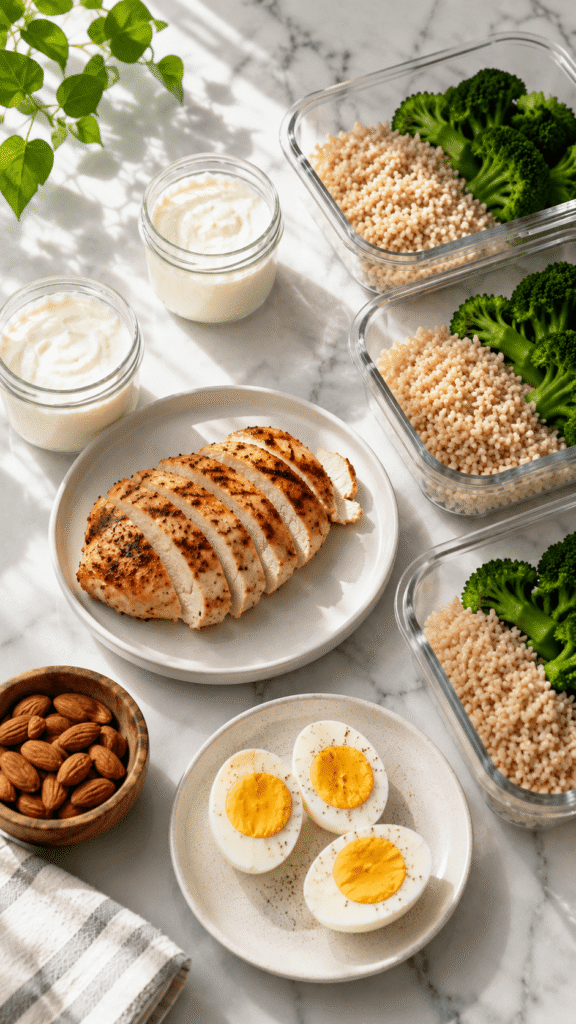
What Exactly Is an “Aggressive Cut” — And Is It Safe?
An aggressive cut means deliberately eating 500–750 calories below what your body burns each day — while keeping protein high enough that your muscles stay protected.
For most people, that puts daily intake somewhere between 1,200 and 1,500 calories, with protein making up about 35–45% of what you eat. This plan sits at roughly 1,400–1,480 calories per day, with 140–160g of protein. It’s aggressive — but not reckless.
Done right, this approach is safe for 1–4 weeks at a stretch. Here are the rules that keep it that way:
- Protein stays at 130g or above. This is the single most important number. Enough protein means your body burns fat for fuel instead of breaking down muscle. It also keeps you fuller for longer — which matters enormously when calories are low.
- Never drop below 1,200 calories. Below this level, your metabolism starts to slow, your energy crashes, and nutrient deficiencies creep in. This plan doesn’t go near that threshold.
- Water is non-negotiable. Aim for 2.5–3 litres a day. Your brain genuinely cannot tell the difference between hunger and thirst. A glass of water before you reach for a snack fixes this more often than you’d expect.
- Cycle your cuts. After 2–4 weeks of cutting, take a week at maintenance calories before cutting again. Diet breaks aren’t weakness — they reset your hormones and make the next cut more effective.
⚠️ Important: If you have any medical conditions, a history of disordered eating, or are pregnant or breastfeeding, please talk to your doctor before starting any calorie-restricted diet plan.
The Full 7-Day Aggressive Cut Meal Plan— Every Meal Mapped Out
Each day comes in under 1,500 calories with at least 130g of protein. Meals are intentionally simple and repeatable — because the plan you actually follow beats the perfect plan you abandon on Wednesday.
💡 Quick tip before you start: On any day where you feel genuinely ravenous, add an extra 50g of grilled chicken or fish to your dinner. That’s roughly 60–80 extra calories — completely negligible — but it can be the difference between finishing the week and bingeing at midnight.
| Day | 🌅 Breakfast | ☀️ Lunch | 🌙 Dinner | 🍎 Snack |
|---|---|---|---|---|
| Day 1 | 3 scrambled eggs + 1 slice whole wheat toast + black coffee | Grilled chicken salad — 150g chicken, mixed greens, cucumber, 1 tbsp olive oil + lemon | Baked salmon (150g) + steamed broccoli + ½ cup brown rice | 1 cup non-fat Greek yogurt + ½ cup blueberries |
| Day 2 | Protein oatmeal — ½ cup oats + 1 scoop protein powder + almond milk | Turkey lettuce wraps — 150g ground turkey, lettuce, tomato, mustard | Lean beef stir-fry — 120g beef strips, mixed veg, low-sodium soy sauce + ½ cup brown rice | 2 hard-boiled eggs + 10 almonds |
| Day 3 | Spinach & feta omelette — 4 egg whites + 1 whole egg | Tuna salad — 1 can tuna in water, celery, light mayo on 2 rice cakes | Grilled chicken breast (180g) + roasted asparagus + side salad | 1 cup low-fat cottage cheese |
| Day 4 | Greek yogurt parfait — 1 cup yogurt + ¼ cup granola + strawberries | Leftover chicken (from Day 3) + steamed broccoli + ½ cup quinoa | Baked tilapia (150g) + sautéed zucchini + ½ cup lentils | 1 apple + 1 tbsp almond butter |
| Day 5 | 3 scrambled eggs + ½ cup sautéed spinach + black coffee | Chicken burrito bowl — 150g chicken, ½ cup black beans, salsa, lettuce (no rice) | Shrimp stir-fry — 180g shrimp, bell peppers, onion, garlic, low-sodium soy sauce + ½ cup brown rice | 1 cup non-fat Greek yogurt |
| Day 6 | Protein smoothie — 1 scoop protein, 1 banana, almond milk, 1 tbsp peanut butter, ice | Tuna wrap — 1 can tuna, whole wheat tortilla, spinach, ¼ avocado, lemon | Lean pork tenderloin (150g) + roasted small sweet potato + green beans | 2 hard-boiled eggs |
| Day 7 | 3 scrambled eggs + ½ cup black beans + salsa | Big protein salad — mixed greens, 150g grilled chicken, ¼ cup chickpeas, cucumber, balsamic vinegar | Baked salmon (150g) + steamed broccoli + side salad with lemon dressing | 1 cup cottage cheese + ½ cup pineapple chunks |
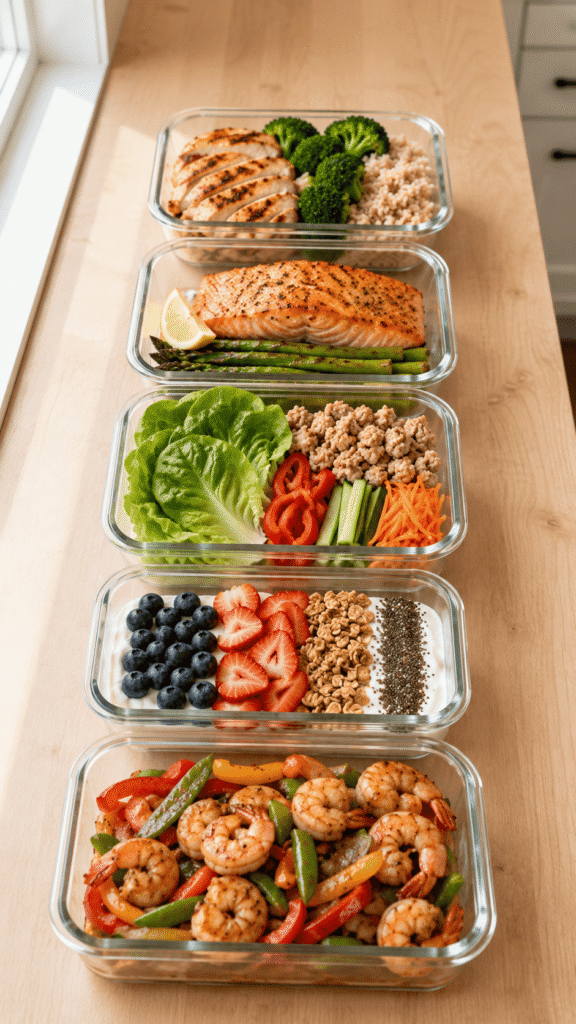
Daily Macros Breakdown
You don’t need to be a nutrition scientist to track your macros. You just need to know the four numbers that matter — and roughly why each one exists.
| Macro | Daily Target | Why it matters |
|---|---|---|
| Calories | 1,400–1,480 kcal | Creates the deficit for fat loss without crashing your metabolism or energy levels |
| Protein | 140–160g | Preserves lean muscle, keeps you fuller longer, and actually burns more calories to digest than carbs or fat |
| Carbohydrates | 100–130g | Fuels your brain and workouts. Focus on fibrous, complex sources — oats, brown rice, vegetables, legumes |
| Fat | 40–55g | Supports hormone production, helps absorb fat-soluble vitamins (A, D, E, K), and makes meals satisfying |
| Fiber | 25g minimum | Slows digestion, feeds your gut bacteria, and is arguably the most underrated hunger-suppressing nutrient there is |
Don’t stress about hitting these numbers exactly every single day. Think of them as a weekly average. If Wednesday comes in at 1,550 calories, just aim for 1,350 on Thursday to balance it out. Perfection isn’t the goal — consistency is.
💡 The one number to protect above everything else: Protein. If you’re going to track one macro on this plan, make it protein. Hit 130g minimum every day and the rest takes care of itself remarkably well.
Your Complete Grocery List — Screenshot This Before You Shop
This list covers all 7 days. The strategy: shop once, prep twice (Sunday and Wednesday). Ninety minutes each prep session and you’re set for the entire week.
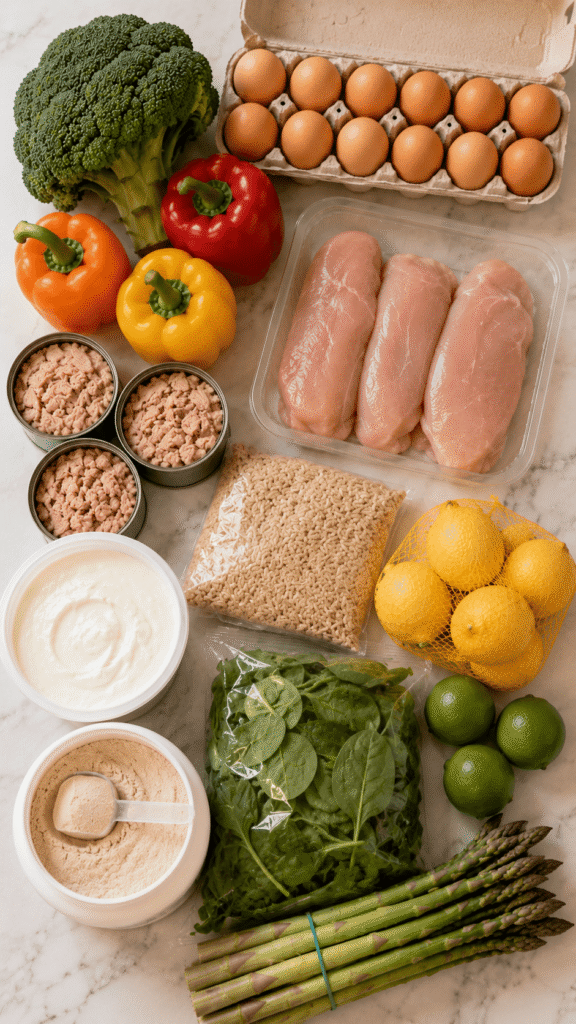
🥩 Proteins
- Chicken breasts — 1.2 kg (about 2.5 lbs)
- Salmon fillets — 450g (3 fillets)
- Tilapia or any white fish — 300g (2 fillets)
- Shrimp, peeled & deveined — 360g
- Lean pork tenderloin — 300g
- Ground turkey, 93% lean — 300g
- Canned tuna in water — 3 cans
- Eggs — 2 dozen
- Non-fat Greek yogurt — 4 large tubs (500g each)
- Low-fat cottage cheese — 2 tubs (500g each)
- Protein powder, whey or plant-based — 1 container
🥦 Vegetables
- Broccoli — 2 large heads
- Asparagus — 1 bunch
- Baby spinach — 2 bags
- Mixed salad greens — 2 bags
- Zucchini — 3 medium
- Bell peppers, mixed colours — 4
- Cucumber — 2
- Tomatoes — 4
- Celery — 1 bunch
- Green beans — 1 bag (frozen works perfectly)
🍓 Fruits
- Blueberries — 1 pint (fresh or frozen)
- Strawberries — 1 pint
- Bananas — 3
- Apples — 2
- Pineapple chunks — 1 small can or fresh
🌾 Grains & Complex Carbs
- Brown rice — 1 bag (2 lbs)
- Quinoa — 1 bag (1 lb)
- Rolled oats — 1 container
- Whole wheat tortillas, small — 1 pack
- Whole wheat bread — 1 loaf
- Plain rice cakes — 1 bag
- Sweet potatoes, small — 2
🫘 Legumes
- Canned black beans — 2 cans
- Canned chickpeas — 1 can
- Lentils, dry or canned — 1 bag or can
🫒 Fats & Condiments
- Olive oil — 1 bottle
- Almond butter — 1 small jar
- Raw almonds — 1 small bag
- Avocados — 2
- Light mayonnaise — 1 small jar
- Low-sodium soy sauce — 1 bottle
- Mustard, yellow or Dijon — 1 bottle
- Salsa — 1 jar
- Balsamic vinegar — 1 bottle
- Lemons — 4
- Crumbled feta cheese — 1 small pack
🛒 Other Essentials
- Unsweetened almond milk — 1 carton
- Low-fat granola — 1 small bag
- Fresh garlic — 1 head
- Onions — 2
- Black coffee or green tea
Estimated total cost: $70–$90 USD. Buying chicken and fish in bulk and freezing them brings this down noticeably. Frozen vegetables are just as nutritious as fresh and significantly cheaper — use them freely.
📌 Save this post to Pinterest so you can find it again when you need it.Screenshot the grocery list before you head to the store — it’ll save you from doing mental maths in the aisle.
5 Habits That Separate People Who Finish the Week From People Who Quit on Day 3
The meal plan is the easy part. Honestly. What trips people up isn’t the food — it’s the psychology around food when they’re tired, stressed, or bored. Here’s what actually makes a cut work.
1. Meal prep on Sunday (and again on Wednesday)
Cook your chicken, rice, and vegetables in bulk twice a week. It takes about 90 minutes each time. Put everything in clearly labelled containers in the fridge, and the only decision you have to make at 7pm on a Tuesday is which container to grab. When your food is already made, the decision is already made. This single habit eliminates the #1 reason people fall off a diet: they’re hungry, tired, and can’t be bothered to cook from scratch.
2. Use MyFitnessPal — but only for the first three days
Track everything you eat for the first three days. Not obsessively, not forever. Just long enough to calibrate. Most people are genuinely shocked by how many calories are hiding in olive oil, salad dressings, and “healthy” granola. Three days of careful logging builds nutritional awareness that influences your choices for weeks — without turning food into a maths exam every evening.
3. Drink a full glass of water before every meal
Drink 300ml of water about five minutes before you sit down to eat. A study published in the journal Obesity found this reduced mealtime calorie intake by an average of 13%. It costs nothing. It takes 30 seconds. And on a low-calorie plan, every tool that blunts hunger is worth using.
4. Guard your sleep like it’s part of the plan — because it is
This one surprises people. Sleep deprivation raises ghrelin (the hormone that makes you feel hungry) and suppresses leptin (the hormone that tells you you’re full). One bad night of sleep can make the cravings you face the next day feel genuinely impossible to resist. Seven to eight hours of sleep on a cut isn’t optional. It’s as important as the food.
5. Keep an emergency snack ready before the 9pm hunger hits
Decide right now — before you’re hungry — what you’ll eat if you’re starving in the evening. Put a container of Greek yogurt and a bag of rice cakes in a visible spot in your fridge and pantry. When the craving arrives (and it will), you want a pre-decided, low-calorie option within arm’s reach. Remove the decision. Remove the failure point. This is the principle behind the whole plan: structure beats willpower, every time.
Want to Go Deeper? The Best Fat-Loss Programs Right Now
This 7-day plan works. But honestly? One week of structure is just the beginning. If you want a fully personalised approach — one built around your exact body weight, metabolism, food preferences, and schedule — a dedicated program takes over where a generic plan leaves off.
These are the two I recommend most often, and the ones I’d point a friend toward depending on what they’re looking for.

🥤 Easiest to Follow
1. The Smoothie Diet
Here’s what I love about this one: it removes cooking entirely from the equation. The Smoothie Diet is a 21-day rapid weight loss program that replaces two meals a day with nutritionally complete, calorie-controlled smoothies. Each recipe is specifically designed to hit protein and fiber targets, which makes hunger dramatically easier to manage than on a standard meal-based diet. The recipes are genuinely good — this isn’t a “chug a green sludge” situation.
If you’re someone who dreads cooking, hates cleaning up, or just wants the absolute simplest path to a calorie deficit, this is the one.
Best for: People who want quick, visible results without spending time in the kitchen, or those who find tracking calories on solid food meals frustrating.→ Try the 21-Day Program
⏱️ Best for Flexibility
2. Eat Stop Eat
If the idea of tracking every meal every day sounds exhausting, Eat Stop Eat offers a completely different approach. Created by Brad Pilon — a nutrition researcher with a Master’s degree in Applied Human Nutrition — it’s an intermittent fasting protocol where you do one or two 24-hour fasts per week. That weekly deficit does the heavy lifting without requiring daily calorie restriction. The science behind it is solid, and it pairs brilliantly with the meal plan above if you want to amplify results without changing what you eat on non-fasting days.
Fair warning: the first fast feels harder than it actually is. By the second or third time, most people are surprised by how manageable it becomes.
Best for: People who want a flexible, research-backed approach to fat loss and prefer not to track food every single day.→ Learn More About Eat Stop Eat
Your Questions Answered — Honestly
These are the questions I get asked most often about cutting. I’m going to answer them the way I’d answer a friend — no fluff, no hedging.
How much weight can I actually expect to lose in 7 days?
Most people lose between 1.5 and 3.5 lbs (0.7–1.6 kg) in the first week. A chunk of that is water weight — especially if you’ve been eating a lot of carbs or sodium — but genuine fat loss starts within 48–72 hours of maintaining your deficit. Expect roughly 0.5–1 lb of actual fat loss per week at this calorie level. It doesn’t sound dramatic, but 1 lb of pure fat per week is significant — and it’s sustainable without muscle loss.
Is 1,500 calories too low for me?
For most women, 1,400–1,500 calories is a moderate-to-aggressive deficit. For most men, it’s aggressive. Both are safe for 1–4 weeks. If you’re very active — training hard 5+ days per week — add 100–150 calories on training days from lean protein sources like Greek yogurt or an extra portion of chicken. If you’re sedentary, 1,400 calories is more than enough to see significant results.
Should I work out while on this plan?
Yes — and I’d really encourage it. Resistance training (lifting weights, bodyweight exercises) while in a calorie deficit is the single most effective way to preserve muscle and speed up fat loss. Aim for 3–4 sessions per week of moderate intensity. Keep cardio to 20–30 minutes of brisk walking or light cycling — long, intense cardio sessions in a severe deficit tend to increase hunger and slow recovery without meaningful extra fat loss.
I’m vegetarian and don’t eat fish. Can I still follow this?
Absolutely. Replace fish and chicken with firm pressed tofu, tempeh, or seitan. Cottage cheese and Greek yogurt are already in the plan and are excellent vegetarian protein sources. Boost legumes — lentils, chickpeas, and black beans are genuinely underrated protein sources — and add a daily protein shake to close any gaps. The macro structure stays exactly the same; only the protein sources change.
Do I need to buy protein powder for this plan?
No. The plan hits 130g+ of protein from whole foods alone. That said, a single daily protein shake (one scoop ≈ 25g protein, 120 calories) makes hitting your targets considerably easier and quicker, especially on busy days. If supplements aren’t your thing, just swap any shake meal for an extra serving of cottage cheese, a couple of eggs, or extra Greek yogurt.
Can I follow this plan for more than a week?
Yes — for up to 3–4 weeks. After that, take a 1–2 week break at maintenance calories (enough to maintain your current weight without gaining or losing) before starting another cut cycle. Prolonged calorie restriction without breaks slows your metabolism, raises cortisol, and makes the next phase of fat loss significantly harder. Diet breaks are strategy, not failure.
What’s the real difference between an aggressive cut and a crash diet?
Protein and structure. A crash diet slashes calories randomly — usually gutting carbs and fat while leaving protein dangerously low. The result is rapid muscle loss alongside fat loss, energy crashes, and a metabolic slowdown that almost guarantees weight regain the moment you stop. An aggressive cut keeps protein high (protecting muscle), maintains micronutrient intake through whole foods, and uses a moderate deficit that your body can adapt to without going into starvation mode. An aggressive cut meal plan and a crash diet share the same goal — completely different outcomes.
You’ve Got the Plan. Now Go Use It.
Screenshot the grocery list. Set a Sunday meal prep alarm. Pick your emergency snack right now before you close this tab.
The difference between people who reach their goals and people who don’t usually isn’t motivation. It’s preparation. You’ve just done the preparation. The rest is just showing up.
📌 Found this helpful? Pin it so you can come back to it. And if you’re sharing it with someone who’s been trying to lose weight — send it their way. This is exactly the kind of plan that actually works when people actually follow it.